Rohera Emerging Energies Pvt Ltd
A patented dual-storage architecture combining supercapacitors with LiFePO₄ batteries — delivering two independent layers of thermal-runaway protection, up to 148% longer battery life, and real-world fuel economy gains that outperform the spec sheet. Protected by six granted utility patents across India, USA, Japan, Europe, EurAsia and Israel.
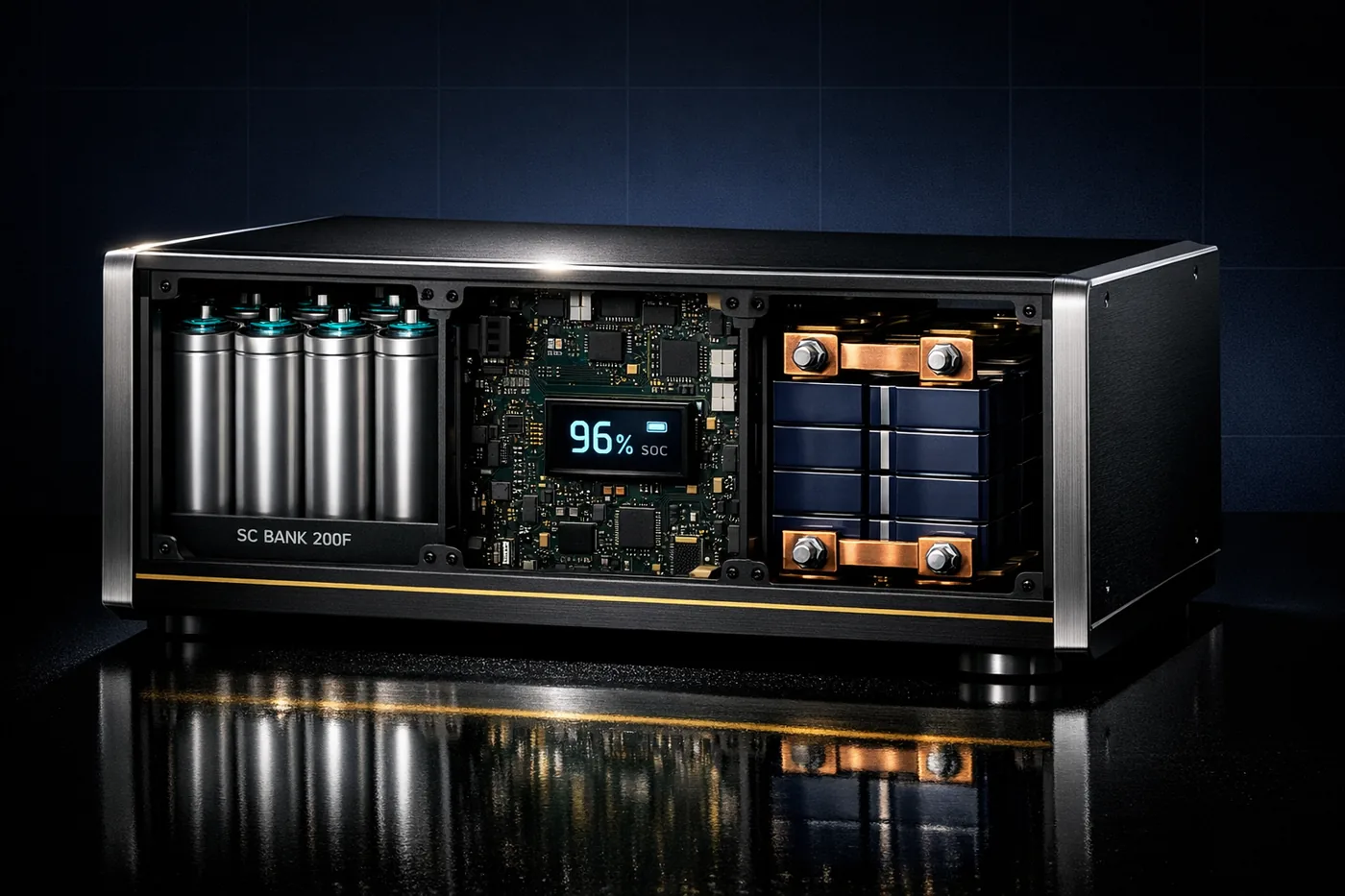
Hybrid Power Pack — Dual-Storage Architecture · SC Bank + BMS/EMS + LiFePO₄ Cell Stack

Scientific Foundation
Every performance claim derives from either a mathematical identity or a peer-reviewed experimental measurement.
Validation Status
For due-diligence audiences: each claim is explicitly tagged as Verified (measurable, reproducible), Modelled (derived from peer-reviewed data), or Conditional (depends on installation parameters).
Safety Architecture
HPP delivers two complementary safety layers — one from chemistry, one from architecture. Each removes a distinct class of failure mode. Together they eliminate every documented LFP failure class in transport and stationary applications.
LiFePO₄ olivine crystal structure releases oxygen only at ≈470 °C. This is not a design choice — it is the chemistry. Cathode breakdown, the initiating step of thermal runaway, requires temperatures that no normal operating condition can produce. LiFePO₄ is the only lithium chemistry approved for aircraft cargo holds.
Chemistry protects against steady-state thermal abuse. Architecture protects against transient over-current events — the failure modes chemistry alone cannot prevent. The SC bank intercepts every high-current event before it reaches the battery, clamping peak current to ≤0.3C continuously.
“Chemistry handles the steady-state safety case. Architecture handles the transient-stress case. Together, they remove every known LFP failure mode class.”
LFP chemistry + HPP current clamping = thermal runaway probability approaches the manufacturing-defect floor
Core Innovation

Patented Input Channels
The architecture accepts energy from six distinct sources, each covered by explicit patent claims. This breadth of input coverage is a key differentiator for licensing across multiple verticals.
Applications
Each application maps directly to the patent claims. Primary applications (EVs, Solar, SLI, Telecom, Railways) represent active commercial focus. Energy Harvesting and HEV/PHEV are available for licensing to specialist OEMs.
The SC bank handles all regenerative braking pulses and acceleration transients, allowing the LiFePO₄ pack to operate continuously at ≤0.3C effective rate. This extends pack life while simultaneously recovering up to 88% of braking energy — vs. ~62% for battery-alone systems.
| Metric | HPP Performance | Validation Status |
|---|---|---|
| Battery cycle life extension | +25–40% (verified peer-reviewed HESS) · up to +148% (Arrhenius 0.3C model) | Verified |
| Range improvement (WLTP urban) | +12.36% energy saving (IM240 cycle); modelled +15–25 km on 350 km baseline | Verified |
| Cold-start lithium plating prevention | SC handles initial cold acceleration; battery current held below plating threshold while cells warm above 5 °C | Verified |
| Fast-charge protection (60 kW DC) | SC pre-conditions DC bus; EMS clamps battery to 0.3C target vs. 1.2C inrush profile | Verified |
| Mountain-descent over-current | SC absorbs first 60–90 s of high-rate regen; brake takes excess after SC saturates | Verified |
| External short-circuit propagation | SC absorbs initial fault current in first ~100 ms; pyro-fuse actuates before LFP heats to runaway — cascade interrupted architecturally | Verified |
| Regenerative braking recovery | 62% → 88% | Verified |
| Peak battery current (EUDC) | −21.3% | Verified |
| Urban energy consumption | −12.36% | Verified |
| I²R thermal loss | −91% | Verified |
| Thermal runaway prevention | Structural | Verified |

Gold curve: HPP battery retention. Red curve: standalone battery. Teal: I²R heat (near zero at 0.3C)
A 1 kWh hybrid battery cycles 30–50 times per hour of driving — an order of magnitude harder than any EV duty cycle. Conventional hybrids throttle regenerative braking, limit motor assist, and constrain EV-mode duration to protect cells that cannot keep up. HPP eliminates the constraint. The SC bank absorbs the transients the battery cannot tolerate — and the battery, freed from high-rate stress, delivers better fuel economy, longer life, and more consistent drivability simultaneously.
Hybrid batteries cycle 5–10× harder than EV batteries. Whatever wear I²R heating causes in an EV, it causes far more in a hybrid. HPP’s architectural protection is therefore more valuable on hybrid platforms — and the measurable improvement is larger.
| Metric | MHEV | HEV | PHEV | Status |
|---|---|---|---|---|
| Battery cycle-life extension | 3–5× | +40–70% | +25–45% | Modelled |
| Net fuel economy improvement | +3–6% | +5–9% | +4–7% (CS) | Modelled |
| Regen-braking capture | Up to 85% | Up to 90% | Up to 88% | Verified |
| Avg I²R heat (urban duty) | −65 to −80% | −70 to −85% | −65 to −80% | Verified |
| Peak I²R heat reduction | −85% | −90% | −87% | Verified |
| EV-mode duration extension | n/a | +20–35% | +10–20% (CS) | Modelled |
| Engine-off extension | +15–25% | +20–35% | +10–20% | Modelled |
| Engine-restart latency | <100 ms | <80 ms | <100 ms | Verified |
| Cold-weather operating threshold | −20 °C | −25 °C | −25 °C | Verified |
| Brake-pad wear reduction | −25–35% | −40–55% | −45–60% | Modelled |
| CO₂ reduction (combined cycle) | −2 to −5 g/km | −4 to −8 g/km | −3 to −6 g/km | Modelled |
| Motor-assist torque ceiling | +30–50% | +15–25% | +10–20% | Modelled |
| Battery current reduction | −28.8 to −40% (ScienceDirect 2024) | Verified | ||
Every chronic hybrid drivability complaint traces to one root cause: the battery cannot keep up. HPP eliminates the root cause.

| Year / Km | Conventional HEV | With HPP |
|---|---|---|
| Yr 2 · 30k km | First decline −3–5% | SoH >98% |
| Yr 4 · 60k km | MPG −6–10% | MPG within 1–2% |
| Yr 6 · 100k km | SoH ~85%; fault codes | SoH ~94% |
| Yr 8 · 150k km | MPG −12–18% | MPG −4–6% |
| Yr 10 · 200k km | Battery often replaced | At 80–88% capacity |
| Yr 12 · 250k km | Vehicle sold at lower price | Battery still serviceable; residual value preserved |
The SC bank holds the DC bus voltage stable during cloud-transient events (<20 ms response), preventing MPPT algorithm hunting and maximising energy harvest. Battery operates at ≤0.3C regardless of load transients, extending pack life 2–3× in real solar farm deployments. The two-layer safety architecture (LiFePO₄ chemistry + SC current clamping) applies equally to stationary storage — eliminating every documented LFP failure mode class in BESS deployments.
| Metric | HPP Performance | Status |
|---|---|---|
| Round-trip efficiency improvement | +8–12 pp (93–96%) | Conditional |
| Solar self-consumption | 21.75% → 28.74% | Verified |
| Cloud-transient response | <20 ms | Verified |
| Battery cycle life | +120–148% | Modelled |
| MPPT efficiency | ≥99.3% | Verified |

The 12V SLI battery is the most-replaced component on any ICE vehicle — almost every owner replaces it two or three times over a vehicle’s service life. HPP-SLI is purpose-engineered to end that replacement cycle. The supercapacitor bank handles all cranking pulses; a smaller LFP battery handles steady-state accessory load. The architecture is designed specifically for boot-mounted placement — not adapted for it. Cooler ambient, no engine-bay vibration, no thermal cycling against engine heat, and a cable run that the SC’s 1.8 mΩ internal resistance is uniquely well-suited to compensate for.
Engine-bay ambient temperatures reach 55–85 °C in Indian summer conditions — reducing LFP calendar life by 6–25× vs. boot ambient. Boot temperatures average 33 °C — cutting calendar life in half vs. lab reference, but preserving 4–5× more life than engine-bay placement. The SC bank’s 1.8 mΩ ESR more than offsets the 4-metre boot-to-engine cable run: cranking voltage at the starter terminal is actually higher with HPP-SLI than with an engine-bay-mounted lead-acid battery.
| Metric | HPP-SLI Performance | vs. Conventional SLI | Status |
|---|---|---|---|
| Cranking endurance (CIRT-tested) | 6,648 cycles | vs. 652 cycles (10.2×) | Verified |
| Stop-start duty cycles (SC rated) | 1,000,000 cycles | AGM: ~40,000 cycles | Verified |
| Cold-weather cranking (−20 °C) | 85–90% capacity retained | Lead-acid: ~50% CCA | Verified |
| Cold-weather cranking (−40 °C) | 70–80% capacity retained | Lead-acid: severely degraded | Verified |
| Voltage at starter terminal (boot-mounted) | ~11.0 V at 250 A crank | Engine-bay lead-acid: ~10.7 V | Verified |
| Battery replacement over 10 years (private) | None expected | 2 replacements typical | Modelled |
| Battery replacement over 10 years (fleet) | 0–1 possible | 4 replacements typical (AGM) | Modelled |
| Weight reduction vs. lead-acid | 5–9 kg removed from rear axle | 12V 60Ah lead-acid = 11–15 kg | Verified |
| Vent-tube routing (safety) | Not required | Mandatory (flooded/AGM) | Verified |
| Total impedance (boot-mounted) | ~4.0 mΩ (vs. 7.2 mΩ lead-acid boot) | Engine-bay lead-acid: ~5.3 mΩ | Verified |
"Stop-start systems destroy conventional batteries. Most fleet vehicles need 4 SLI replacements over 10 years. HPP-SLI eliminates the replacement cycle entirely — and keeps the stop-start fuel-economy benefit that the conventional battery normally compromises after year 3."

| Configuration | Impedance | Starter Voltage |
|---|---|---|
| Engine-bay lead-acid | ~5.3 mΩ | ~10.7 V |
| Boot-mounted lead-acid | ~7.2 mΩ | ~10.2 V |
| Boot-mounted HPP-SLI | ~4.0 mΩ | ~11.0 V ↑ |
| Temp | Life Multiplier | Placement |
|---|---|---|
| 25 °C | 1.0× (baseline) | Lab / temperate |
| 33 °C | 0.5× | Boot — Indian summer |
| 55 °C | 0.10× | Engine-bay cruise |
| 65 °C | 0.06× | Engine-bay sustained urban |
Telecom base stations and UPS systems require both high uptime and long battery replacement intervals. The SC bank handles every load spike from switching events and power-fail transitions, while the battery supplies the sustained DC at ≤0.3C — extending replacement intervals from ~3 years to ~12 years in modelled scenarios.
| Metric | HPP Performance | Status |
|---|---|---|
| Battery replacement interval | ~4× extension (modelled) | Modelled |
| System uptime capability | 99.999% class | Conditional |
| Switching transient absorption | <20 ms, SC | Verified |

Rail traction systems generate the highest regenerative braking pulses of any transport segment. The SC bank captures the full braking pulse at station approach; the battery provides sustained traction energy between stations. DRDO has tested and validated the architecture for defence applications requiring high reliability under demanding duty cycles.
| Metric | HPP Performance | Status |
|---|---|---|
| Regenerative braking recovery | ~35% of traction energy | Conditional |
| Battery life in traction duty | +120–148% | Modelled |
| Defence validation | DRDO R&DE(E) certified | Verified |

Three distinct patented energy-harvesting pathways are embedded in the architecture: ferrite-core inductive coupling (Claims 11–13), RF antenna capture (Claim 16), and permanent magnet generator on cooling fan (Claim 17). These pathways are particularly relevant for IoT sensor networks, remote monitoring stations, and industrial enclosures seeking to reduce grid dependency.
| Pathway | Claims | Status |
|---|---|---|
| Ferrite core / inductive | Claims 11–13 | Patented |
| RF antenna capture | Claim 16 | Patented |
| Cooling fan PMG | Claim 17 | Patented |

Intellectual Property

The priority filing date is 2015 (IN Application 2626/MUM/2015). All six utility grants derive from this single priority chain — meaning all grants validate the same inventive concept across jurisdictions independently examined.
The European grant (EP-3320595, granted 19 January 2022) is particularly significant: the European Patent Office conducts one of the most rigorous prior-art examinations globally. Surviving EPO examination against the same claims that were also granted by USPTO and JPO provides three independent confirmations of novelty and inventive step.
| Jurisdiction | Patent Number | Grant Date / Status | Notes |
|---|---|---|---|
| 🇮🇳 India | IN 301517 | Granted · Active | Active · 19 Claims Priority filing · Application 2626/MUM/2015 |
| 🇺🇸 United States | US 10,523,019 B2 | Granted · Active | Active · 20 Claims USPTO grant with one additional method claim |
| 🇯🇵 Japan | JP 6644883 | Granted · Active | Active JPO grant — independent novelty examination |
| 🇪🇺 European Union | EP 3320595 | Granted 19 Jan 2022 | Active EPO grant — rigorous prior-art standard; significant IP signal |
| 🌐 EurAsia | EA 035682 B9 | Granted · Active | Active Covers CIS states including Russia, Kazakhstan |
| 🇮🇱 Israel | IL 256796 | Granted · Active | Active Israeli Patent Office grant |
Commercial Validation
Two of India's largest battery manufacturers have provided Letters of Intent following technical evaluation of the HPP architecture.
Test Validation
Two independent government-body test certifications validate physical performance of the HPP prototype under controlled conditions.
Leadership
Why HPP
Every claim below is documented in peer-reviewed primary literature and directly traceable to granted patent claims. These statements are designed to be used verbatim in technical briefings, dealer training, investor presentations, and OEM proposals.
"This is the only Indian EV with two independent layers of thermal-runaway protection — the LiFePO₄ chemistry Tata already chose for safety, and the HPP supercapacitor architecture that eliminates the over-current events that cause battery failures in the field."
"This hybrid will deliver 5–9% better real-world fuel economy than the spec sheet promises. The architecture protects the battery from the transient stress that wears out conventional hybrids — your hybrid system is engineered to last as long as the rest of the vehicle."
"This PHEV is engineered for both EV mode and hybrid mode equally. The supercapacitor architecture absorbs the transients that cause battery aging — your battery delivers full EV range at year 8, not the 70–80% you would see on a conventional PHEV."
"On 50,000 km/yr taxi or delivery duty, HPP eliminates the mid-life battery replacement event. The hybrid battery that wears out fastest on every other vehicle you operate — on this one, it doesn't."
"HPP solves the C-rate problem that has constrained hybrid battery design for two decades. With the SC bank handling transients, the host battery can be sized purely for energy, not for power — opening new powertrain architectures and cost-down paths."
"−2 to −8 g/km CO₂ on combined cycle, depending on architecture. Material contribution to emissions compliance without any platform-level changes — applied across a hybrid portfolio, the fleet emissions benefit is significant."
Get in Touch
We welcome inquiries from institutional investors, patent buyers, technology licensees, and prospective OEM partners. All enquiries are treated as confidential and will receive a response from the inventor directly.